Sunday, December 5, 2010


Quote from the book: "It's often said that writers should never explain their work, but perhaps we could agree that these are exceptional circumstances. Normally when you write a novel , it's not a thing that has simply one meaning. Some people will read a scene and find it funny or satirical, others read it and find it sad or spiritual. Usually you don't have to choose between the two versions: the writer can allow both meanings to exist. But I've been put in a position where I have to say 'what I really meant.' It's a very strange thing to be doing, because, as anyone who writes a novel knows, not all the effects are planned--things happen on a page." (132)

Mr. Salman Rushdie said this in an interview with Blake Morrison, a journalist for Granta, in 1990. It is in reference to the controversy that surrounds his most recent masterpiece, The Satanic Verses, in which the Islamic prophet, Mohammad, professes to a semi-polytheistic streak in the religion of submission. This streak has been thrown around at various theological and Islamic conferences and university halls, and has resulted in a fatwa issued by Ruhollah Khomeini, an ayatollah (high-ranking Islamic clerk), that encouraged the Muslims of the world to assassinate him. Rushie intended the book to have multiple meanings after which he explained that he works just like every other author. To defend himself and his family he clarified to the public his intentions of the book and received protection of the United Kingdom.

Connections: Salman Rushdie's national and ethnic identity is extremely postmodern. He is modern in the sense that he was raised was born in a post-colonial India to (rather liberal) Muslim parents with money who sent him to Rugby and University of Cambridge in the United Kingdom for his secondary and postsecondary education; he is a foreigner who maintains his native identity. He is postmodern because of his need to add temporal dimensions to his identity in order to survive mishaps. Rushdie elaborates on some of the possibly racist bullying he experienced at Rugby, and how he tried to assimilate to a single-sex, British, independent school culture. He also talks about how during the The Satanic Verses controversy he made press statements that stated how he was a religious Muslim, only to publish an article in The Times that basically refuted this because he wanted to decrease the death threats.

In the same interview with Blake Morrison, Rushdie expresses his desire for The Satanic Verses to be published in paperback (it eventually was). His expression was to fight fanaticism that wanted to kill him, an open defiance. His first death threat came when he was in the Penguin publishing headquarters when the secretary took the death threat telephone call. Various people discouraged him from publishing a paperback (which would lead to a wider audience), but Rushdie was adamant on making sure that his book's controversy be alive because if he withdrew his paperback proposal the extremists would win. This connects well to the website Wikileaks because of its controversial information. The website has been the center of controversy from many governments because of the level of secrecy about the information it leaks. Now, The Satanic Verses and Wikileaks differ in that the first has ambiguity in its proposals, but the delivery is controversial because of the number of people it reaches. It feels that with both of these the number of people is what makes a controversy. Sure, some thing can be controversial, as in that it is or has the potential to be the subject of a controversy, but a controversy is strictly determined by the mass of people it pisses off.

Rushdie also reveals a rather political side to him when he talks of his dislike for the theocracy of Iran. He calls the foundation of an Islamic state a "myth" in a sense that makes it sound horrible and inefficient. In his novel Shame he explores the French governmental ideals of liberty, equality, and fraternity and tells the interviewer that the book represents an Iran at the time with certain characters representing Iranian political figures. This relates well to George Orwell's Animal Farm, which is a long metaphor for the Soviet Union's internal political power struggles. In Shame, the book revolves around the pseudo-Pakistan and brings in God to the picture.

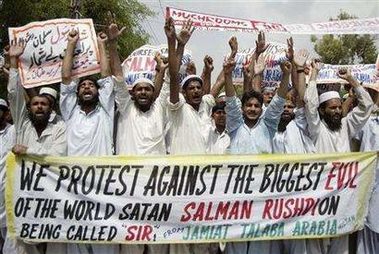
Visual Representation: The picture above is from a protest against Salman Rushdie's knighthood as bestowed by the Queen of the United Kingdom. Rushdie faced many obstacles to exercise his international right to free speech. Even fellow moderate Muslims were against his knighthood appointment. Regardless, there appears to be connection here to Shame. In Shame, a Muslim girl living in the United Kingdom is killed after "dishonoring" her parents. The sense of community around one's family is one that most assume to be granted without request or prior deed. Muslim's are religiously obliged to unity, and this similar phenomenon appears to be working on Rushdie.

Questions: Are there any other authors in the world that have had similar controversies like Rushdie? If controversy is expanded by the number of people who have access to the object of controversy, and if translators have been killed for translating The Satanic Verses, what is the ultimate objective for the governments and people who wish to censor his work? In Noam Chomsky's theory of E- and I-language, people have a natural, mental organ to enable language; how does Salman Rushdie's English-Urdu bilingualism affect his writing? How does Indian literature differ in a temporal context with respect to pre-colonial, colonial, and post-colonial periods? In Shame, the Bhutto political dynasty is obviously represented through one of the characters of power; how have people's voting been affected by this book?

Reflection: While I would have preferred a traditional biography, this collection of interviews was sufficient to write the honors paper. The book provides a very real and unbiased Salman Rushdie who is willing to share his writing techniques, themes, and connections to the real world. It is also very interesting to see the book go in chronological order, which emphasizes Rushdie before and after the publication of The Satanic Verses. It is also obvious to see that Midnight's Children is a famous piece that has a lot of commentary. I look forward to reading that book someday.

Thursday, November 4, 2010


Quote from the book: "No matter how determinedly one feels a country, one is obliged to take along some hand-luggage; and can it be doubted that Omar Khayyam (to concentrate on him), having been barred from feeling shame at an early age, continued to be affected by that remarkable ban throughout his later years, yes, long after his escape from his mothers' zone of influence? Reader: it cannot. What is the opposite of shame? What's left when sharam is subtracted? That's obvious: shamelessness." (33)

This quote exemplifies the overall theme of shame in the novel. It begins with the Shakil sisters giving birth to Omar Khayyam, and mothering him after the sisters' father dies. They live in a grand estate in a country that Rushdie identifies as similar to Pakistan, but not exactly Pakistan (though through political connections, it is obvious that it is Pakistan). Omar does not leave this estate until he is twelve to attend school. Before that he is observing the outside world with a telescope. When the sisters decide to purchase him supplies for school, the city begins to talk about the controversy that has been boiling for years. Omar's life becomes a bit hectic with all of the heckling from firmly Muslim believers and when he fathers a child with a girl he put into a trance that he has been following with his telescope for years. Rushdie continues with this story line and focuses on General Raza Hyder and Prime Minister Iskander Harappa. The two battle for power of this pseudo-Pakistan and bring about their own versions of shame and honor in the contexts of politics and family. The ending can be simply said as this: the general, who in a Western belief system is evil, overthrows Harappa and kills him. In a way, I see how the opposite of shame is not honor, but rather shamelessness, because honor is hard to come by and honor largely goes unnoticed. Shame is always given all of the attention.

Connections: The first connection is with the story's initial baby boy: Omar Khayyam. With his childhood, the theme of isolated upbringing is noticeable. Because the Shakil sisters are staying in their mansion for years, they seem to embody a burka to ignore what the outside world would consider shameful. The mothers birth him miraculously without a father, while still being very ignorant of the idea of human fortification (at first the sisters believe the nipples are the nexus of fertilization). While the rest of the city is aware of a Shakil son, they are not knowledgeable about the idea of there being no father. Omar is born into a world that will subject him to shame because of something that was not his fault. In this instance, shame can be avoided by isolation, proving that shame is purely a social phenomenon; that shame of one's self is often warranted by others. If all humans were isolated from one another, shame would not exist. Shame is about crossing the boundaries of society.

Secondly, we see shame being associated with the female gender. We see this with the Shakil sisters' image of being unwed mothers. In a second case we see this with a small side story in England of a father performing an honor killing on his daughter for having sex with a boy, to which Rushdie comments on pride and important relationships. But perhaps the best example of gender and shame comes from General Raza Hyder fathering a daughter, Sufiya Zinoba, with his wife. General Hyder is adamant on having a son, and even questions her genitalia to the doctor to see if she will become a boy later on in life. Clearly, being a woman is as what the Chinese would say "the birth of a girl is a small joy."

Also, the idea of marianismo becomes screwy with Arjumand Harappa, the daughter of the prime minister, who is known as "virgin ironpants". At one point she is twenty and has not married a boy, which means that she is pure in Qur'anic law, but testy for the city's matchmakers who are desperate for her to attach her to a man, to submit her to a gender hierarchy that utilizes her for making offspring, which requires sexual contact. Also, "Loathing her sex, Arjumand went to great lengths to disguise her looks" (162), showing that femininity is seen as an obligation to a patriarchal system. Arjumand desperately tries to escape her destiny of becoming a mother, but still manages to keep herself a virgin.

Thirdly, Rushdie recognizes himself as the narrator and gives his own personal insight on the subject of shame. Rushdie talks about his encounter with some English elite who were on the subject of this pseudo-Pakistan. Shame, on their eyes, was a common feature of the Middle East; that shame was to be only found in the villages of homes that housed the Qur'an. Rushdie says that shame "is not the exclusive property of the East" (22). However, he does not give an example of shame in the West, save for the Islamic honor killing in England. Perhaps shame in the West is thinking that we Westerners have no shame, and that the East is full of barbarians. I have some belief in this, because Western diplomacy tends to take a parenting, didactic tone to it, especially to developing countries. We, according to us at least, have the best answers, and the rest of the world needs to understand this.

Visual Representation: The picture shows women in Iraq in line to vote. The fence around them is for segregation; in that men have their own line, and women have their own line. Women, as we can see from this photo, are outnumbering men. From the book: "'Suppose you hold elections and he wins, sir,' Colonel Shuka ventured as his face acquired the most dolorous expression Raza had ever seen on the unhappy countenance, ' beg for pardon, sir, but what'll he do to you?' Raza Hyder looked surprised, 'What is this do?' he cried. 'To me? his old comrade, his family member by marriage? Have I tortured him? have I thrown him in the public lock-up? then what is there for him to do?'" (236)

Politics in the pseudo-Pakistan are intense, and Raza does end up in prison and killed. Going back to gender dimensions and Shame, the women seem to be independent and unwilling to go to extreme measures to get their points across. If anything, the women of the book mostly find ways to avoid more problems. So the picture above shows the participation of women in politics, perhaps as a cooling device to prevent more testosterone in bloody politics.

Questions: How do politics in this pseudo-Pakistan relate to the current political state of Pakistan, from the assassination of Benazir Bhutto to today? Why is it that men are preferred in political positions by men, perhaps just for military prowess? What is the literary purpose for the Omar storyline in the beginning only to be stopped for a different one, does that start the reader off with an Eastern shame? In Muslim societies, how does sexual interactions disagree with Islamic law; why is it that the men are not given honor killings for the same crime?

Reflection: Shame is a much easier book to read from Salman Rushdie. While the other book, The Satanic Verses seem like a postmodern film on cocaine, this one takes on a more traditional flow of narration and keeps to one perspective. However, he does stay true to his roots in non-linear story lines, as he switches around with various side stories. Shame I think, would be a better book to read first in order to warm up to his voice.

Shame, overall, gives an easy to follow story while exploring the themes of Islam, gender, and politics. Its title explains most of the trials in the book and gives you a very smart bias to guide you throughout. I would recommend this book to an high schooler because of its easiness to dissect.

Thursday, October 7, 2010


Quote from the book: "...(T)he traitor, Gibreel Farishta, looking down at (Saladin) from the litter balcony outside Rosa's bedroom, and there wasn't any light shining around the bastard's head." (146)

This quote exemplifies the drift of the two main characters, Gibreel Farishta and Saladin Chamcha. When they land onto the United Kingdom's coast after a terrorist attack they are mistaken for illegal immigrants and become the subject of Her Majesty's police force. One character, Chamcha, turns into a demonic-looking character with horns and a goat-like body structure, while the other one, Farishta, becomes a more angelic-looking character with a halo. The devil enters custody while the angel avoids police detention. Throughout the novel, characters and identities with stark contrasts clash vigorously. In this case, it is devil vs. angel, though other contrasts like atheism vs. faith, monotheism vs. polytheism, honor vs. dishonor, and prophet vs. interpreter occur in the contexts of marriage, cities, familiar relationships, and religious grouping. All the while characters already have their minds set on on side. The book is largely about having to choose one of two options when you know you are already disposed to one, and only considering the other to confirm your alliance to a higher belief system.

Connections: The first immediate connection that I found was the Anglo-Indian relation on a cultural level in Indians. Saladin Chamcha's actual name is Salahuddin Chamchawala and was born to a rather orthodox Muslim family. Saladin attended school in the United Kingdom and took on "Saladin" after going through Anglonization and used this as his stage name when his acting agent preferred this. His father, Changez, is adamant on his son maintaining his submission to Islam and an Indian-Muslim identity; with this said he strongly disapproves of his son's wishes to become an actor because this would mean that he would follow a hedonistic lifestyle. He does not want Saladin to be something that Allah did not intend for him to be, which is Changez's view on acting. Obviously this drift has a larger clash: colonist vs. indigenous, and the factor of generations is rather evident. The younger generation, Saladin, favors the new and exotic British life because of the material benefits that come about assimilating to that culture. Meanwhile the older generation, Changez, prefers to keep things traditional and treads on the colonist's land with caution.

With Gibreel, the reader follows his very active sexual life and discovers that he very rarely has sex with Indian women. He prefers European women. This can attest to the concept that whiter, more Westernized looks are preferred over indigenous interpretation of beauty. He too strays away from going back to India and almost detests his life back home.

Secondly, the historical and theological aspects of The Satanic Verses are evident in Muslim theology. Mahound, who is the prophet Muhammad, goes to a mountain and receives messages from the angel Gibreel, the first of which favors the polytheism of Jahilia, a city. While these Satanic verses are labeled as coming from Satan and not the angel, there is still debate on whether Muhammad actually said these words. Further more, larger pieces of theology are aroused when Baal, a skeptic of Muhammad, begins to question if Muhammad is editing the prophesies to cater to his personal agenda. Similarly, Hind, a priestess of the polytheism of Jahilia, wishes to discredit Muhammad. Examining the theological drama in the Middle East is unique in The Satanic Verses because it does not follow the strict and vague voice of the religious texts. We can further imagine the feelings and thought processes of the characters involved, which is something that I think people tend to forget when the study religious texts. Characters in religious texts seem flat.

Thirdly, female characters seem very empowered in the novel, possibly as a statement of the author, Salman Rushdie. The book is filled with characters that have a streak of feminism or with the author's voice that highlights gender equality. For example, one of Gibreel Farishta's colleges, Zeenat Fakil, was loitering at a popular prostitution street drinking soda and smoking a cigarette. The pimps of the street threatened her with bodily harm, but all she did was stare them down and leave slowly. Or rather, how Muhammad's main competitor for prophet of Jahilia is a pagan priestess, Hind. Hind is a very interesting character because she is the wife of a very powerful man of the city, but yet the focus is on her. Also, this character is very sexually liberated without being identified in the Madonna-Whore dichotomy by other characters or with Rushdie's literary voice. Or consider the peon girl who becomes a prophetess with the same angel that came to Muhammad and convinces an entire village to embark on the hajj via a splitting of the ocean. When she decides to go with he female masters, her male master forbids her but does so anyways.

Rushdie -- after doing some research -- turns out to be rather distant from his Muslim upbringing. His feminist characters redefine the West's perception of gender in Islam; where the West considers the Muslim world to be very degrading towards women. Perhaps Rushdie is a strong believer of gender equality and integrated feminist-empowered women in time periods that typically did not allow this to make a statement about women in the Middle East. This anachronism engages the reader to reconsider the gender dimensions in positions of power and theology.

Visual Representation: The picture shown in this post is apart of a terrorist being escorted off a plane by Indonesian police. There is hostage situation in the novel involving Gibreel and Saladin by a group of Indian terrorists whereby the airplane is taken hostage for over 100 days. From the novel: "She's (one of the terrorists) telling them they have to issue and ultimatum ,' Gibreel Farishta said to Chamcha. 'One of us has to die.'" From the looks of the picture, it looks very serious and could be fitted for a hostage situation. When the group of terrorists finally decide to pick a man to kill to raise tensions for their demands, the crew takes off and flies towards London. The crew bickers and eventually destroys the plane.

So to analyze this photo we understand that there is a universal problem with evil: it must bicker with itself. The terrorists in this part of the book represent a petty political cause, one that Rushdie only vaguely identifies as a minor nationalist dispute in India (something that is actually quite common in Indian politics). In this picture, police foil the terrorists' plot and were able to do so because of the selfish planning that probably happened on evil's end. In the novel the terrorists' plot is foiled by themselves for fearing death, and the ultimatum is delivered by blowing herself up while in midair.

Questions: How does Rushdie's Indian and English cultural and literary background contribute to his voice and subject matter? What is the cultural significance of the three gods, and how do these gods differ from the Islamic god? What is the drive for Gibreel Farishta to regain his life after the plane crash: fame, fortune, closure for his fans? What drives a person to leave a religion and to join a completely new one, as in the case with Baal, only to arrive with doubt about the new prophet? Why is it that Gibreel Farishta was reincarnated into the archangel Gibreel and not a regular angel?

Reflection: The Satanic Verses is by far the most difficult book I have read so far, because of its English anecdote and Indian and Arabic diction. I enjoyed the characters because of their train wrecks for lives and of their frankness about their situations. I was not too fond of the side stories of Mahound, Ayesha, and the imam because they would interrupt the story of the two Indian Bollywood actors. Also, I did not appreciate the confusing detail that added spice to the story but drew out the story too long for my memory span to stay attentive. The epicness of the side stories, however, with its antiqued feel was a real treat and offered an oasis to the unfortunate reality of the terrible explosion that occurred over the English channel.

Overall, I would not recommend this story to everyone. The story is highly complex because of its elaboration and would completely go over someone who has not studied the basic skeleton on Islam and Middle Asia. When I am older, possibly in the next few years when I am in university, I will reread this text and understand it more.