Quote from the book: "It's often said that writers should never explain their work, but perhaps we could agree that these are exceptional circumstances. Normally when you write a novel , it's not a thing that has simply one meaning. Some people will read a scene and find it funny or satirical, others read it and find it sad or spiritual. Usually you don't have to choose between the two versions: the writer can allow both meanings to exist. But I've been put in a position where I have to say 'what I really meant.' It's a very strange thing to be doing, because, as anyone who writes a novel knows, not all the effects are planned--things happen on a page." (132)
Mr. Salman Rushdie said this in an interview with Blake Morrison, a journalist for Granta, in 1990. It is in reference to the controversy that surrounds his most recent masterpiece, The Satanic Verses, in which the Islamic prophet, Mohammad, professes to a semi-polytheistic streak in the religion of submission. This streak has been thrown around at various theological and Islamic conferences and university halls, and has resulted in a fatwa issued by Ruhollah Khomeini, an ayatollah (high-ranking Islamic clerk), that encouraged the Muslims of the world to assassinate him. Rushie intended the book to have multiple meanings after which he explained that he works just like every other author. To defend himself and his family he clarified to the public his intentions of the book and received protection of the United Kingdom.
Connections: Salman Rushdie's national and ethnic identity is extremely postmodern. He is modern in the sense that he was raised was born in a post-colonial India to (rather liberal) Muslim parents with money who sent him to Rugby and University of Cambridge in the United Kingdom for his secondary and postsecondary education; he is a foreigner who maintains his native identity. He is postmodern because of his need to add temporal dimensions to his identity in order to survive mishaps. Rushdie elaborates on some of the possibly racist bullying he experienced at Rugby, and how he tried to assimilate to a single-sex, British, independent school culture. He also talks about how during the The Satanic Verses controversy he made press statements that stated how he was a religious Muslim, only to publish an article in The Times that basically refuted this because he wanted to decrease the death threats.
In the same interview with Blake Morrison, Rushdie expresses his desire for The Satanic Verses to be published in paperback (it eventually was). His expression was to fight fanaticism that wanted to kill him, an open defiance. His first death threat came when he was in the Penguin publishing headquarters when the secretary took the death threat telephone call. Various people discouraged him from publishing a paperback (which would lead to a wider audience), but Rushdie was adamant on making sure that his book's controversy be alive because if he withdrew his paperback proposal the extremists would win. This connects well to the website Wikileaks because of its controversial information. The website has been the center of controversy from many governments because of the level of secrecy about the information it leaks. Now, The Satanic Verses and Wikileaks differ in that the first has ambiguity in its proposals, but the delivery is controversial because of the number of people it reaches. It feels that with both of these the number of people is what makes a controversy. Sure, some thing can be controversial, as in that it is or has the potential to be the subject of a controversy, but a controversy is strictly determined by the mass of people it pisses off.
Rushdie also reveals a rather political side to him when he talks of his dislike for the theocracy of Iran. He calls the foundation of an Islamic state a "myth" in a sense that makes it sound horrible and inefficient. In his novel Shame he explores the French governmental ideals of liberty, equality, and fraternity and tells the interviewer that the book represents an Iran at the time with certain characters representing Iranian political figures. This relates well to George Orwell's Animal Farm, which is a long metaphor for the Soviet Union's internal political power struggles. In Shame, the book revolves around the pseudo-Pakistan and brings in God to the picture.
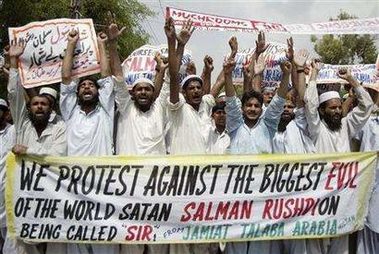
Visual Representation: The picture above is from a protest against Salman Rushdie's knighthood as bestowed by the Queen of the United Kingdom. Rushdie faced many obstacles to exercise his international right to free speech. Even fellow moderate Muslims were against his knighthood appointment. Regardless, there appears to be connection here to Shame. In Shame, a Muslim girl living in the United Kingdom is killed after "dishonoring" her parents. The sense of community around one's family is one that most assume to be granted without request or prior deed. Muslim's are religiously obliged to unity, and this similar phenomenon appears to be working on Rushdie.
Questions: Are there any other authors in the world that have had similar controversies like Rushdie? If controversy is expanded by the number of people who have access to the object of controversy, and if translators have been killed for translating The Satanic Verses, what is the ultimate objective for the governments and people who wish to censor his work? In Noam Chomsky's theory of E- and I-language, people have a natural, mental organ to enable language; how does Salman Rushdie's English-Urdu bilingualism affect his writing? How does Indian literature differ in a temporal context with respect to pre-colonial, colonial, and post-colonial periods? In Shame, the Bhutto political dynasty is obviously represented through one of the characters of power; how have people's voting been affected by this book?
Reflection: While I would have preferred a traditional biography, this collection of interviews was sufficient to write the honors paper. The book provides a very real and unbiased Salman Rushdie who is willing to share his writing techniques, themes, and connections to the real world. It is also very interesting to see the book go in chronological order, which emphasizes Rushdie before and after the publication of The Satanic Verses. It is also obvious to see that Midnight's Children is a famous piece that has a lot of commentary. I look forward to reading that book someday.

No comments:
Post a Comment